

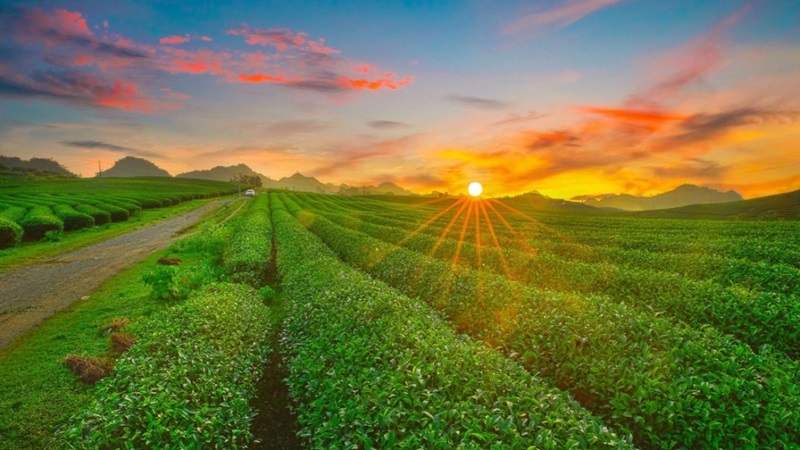
High on Vietnam’s northwestern plateau, Mộc Châu unfurls like a green ribbon of tea. Rows arc and ripple across the hillsides, curving into hearts and spirals that seem designed for a camera’s eye. As the sun sinks behind the mountains, the leaves take on a velvet sheen and the sky blushes from apricot to lilac: a brief, breathtaking transformation. If your question is “Where can I capture the most beautiful sunset photos in Vietnam?” the answer often leads here—Mộc Châu tea hills at golden hour. This guide brings you everything you need to plan, shoot, and savor the moment, from the best seasons and locations to composition tricks, respectful etiquette with farmers, and itinerary ideas that turn a single evening of light into a full, meaningful journey.
Why Mộc Châu Is Made for Sunset Photography
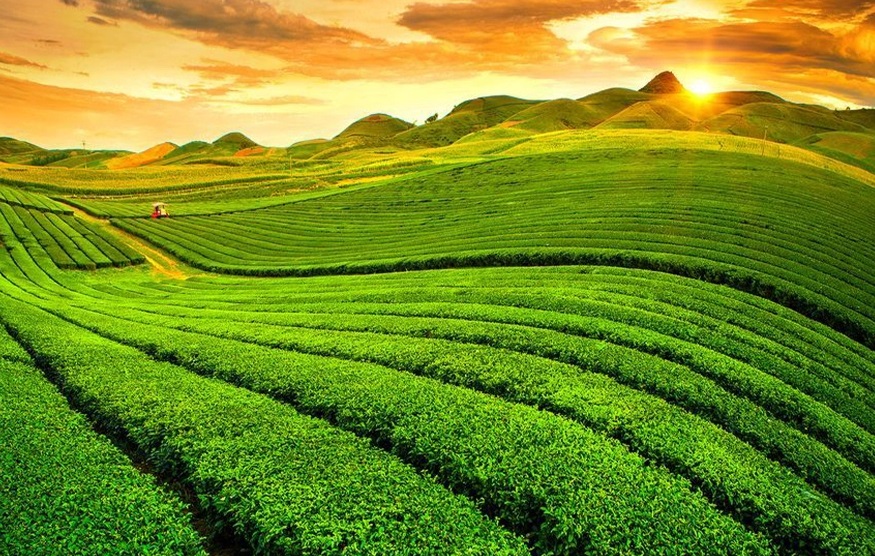
Cradled in Sơn La Province about 200 km west of Hà Nội, Mộc Châu Plateau sits at roughly 1,050 meters above sea level. That elevation buys you cooler air, gentler light, and frequent mists that roll through the valleys in late afternoon—catnip for anyone who loves atmosphere in a landscape shot. The tea itself is the second part of the magic. Because planters have shaped the rows along contours, ridgelines, and terraces, the fields naturally provide leading lines, curves, and repeating patterns that pull a viewer’s gaze straight into the frame.
On many evenings, a thin veil of haze softens distant ridges while the foreground stays crisp and textured. The result is depth: layers of green lines, dusky mountains, and a warm sky. Even when clouds arrive, the tea fields are forgiving—broken sunlight creates patches of brightness that paint the hills in stripes.
When to Go: Seasons, Weather, and Light
Sunset is gorgeous year-round, but each season adds its own personality:
- Spring (Jan–Mar): Cool, clear air. Plum and peach blossoms bloom in nearby valleys (Pa Phách, Nà Sản), perfect for combining floral foregrounds with green tea. Skies can be pristine after cold fronts.
- Early Summer (Apr–Jun): Longer golden hours and punchy sunsets. Afternoon convection can build dramatic clouds; brief showers often clear to glowing post-rain color.
- Late Summer (Jul–Aug): The greenest leaves of the year. Afternoon storms are common—keep rain covers handy—yet storm edges and sunbreaks produce extraordinary light.
- Autumn (Sep–Nov): Balanced weather, calmer winds, excellent visibility. Fields are lush, and mornings can be misty while evenings glow soft and warm.
- Winter (Dec): Chilly sunsets with potential valley fog. The light turns crisp and low; silhouettes against pastel skies work beautifully.
Daily timing: Aim to arrive 45–60 minutes before posted sunset. The best moments often occur 10–15 minutes before and after the sun dips—when the sky’s color peaks and a final edge-light sets the leaves aglow. Don’t leave after the disk vanishes; blue hour reflections on waxy tea leaves can be exquisite.
Where to Shoot: The Most Photogenic Tea Hills
Heart-Shaped Tea Hill (Đồi chè Trái Tim, Tân Lập)
The Instagram icon of Mộc Châu. Planted in a shallow amphitheater, the heart motif pops from both ground level and drone altitude. Late-afternoon side-light sculpts the heart’s outline; step downslope and use a longer focal length to compress the shape. Small entrance fees are common—carry cash and smile at the attendant.
Best angles:
- West-facing rim for side-light and leading lines into the heart.
- Slightly elevated knolls for symmetry.
- Include a lone figure on the path for scale.

Ô Long Tea Hills (đồi chè Ô Long)
Tightly pruned rows form arcs and waves—graphic heaven for patterns and abstracts. The hills undulate more steeply here, so long lenses (70–200mm) compress layers of lines into striking compositions. On hazy days, shoot into the light for a high-key, airy mood.

Tân Lập 1–2–3 (various cooperative farms)
Close to town with convenient access. These fields have broad, sweeping lines and dirt paths that curve elegantly. Great for couples’ portraits at sunset; ask before entering deep rows to avoid damaging young shoots.

Mộc Sương (private plantation)
Occasionally requires permission; when accessible, it offers tiered terraces with dramatic backdrops. The slopes face multiple directions, helpful for catching cross-light or silhouettes against a flaming sky.
Etiquette: Many tea hills are active farms. Stay on paths, avoid stepping between rows, and ask a farmer or guard before flying a drone. A friendly greeting and a small fee go a long way.

The Light: Reading and Shaping It
- Backlight (sun behind subject): Tea tips glow with translucent edges; perfect for dreamy textures. Expose for highlights (use exposure compensation: –0.3 to –1.0 EV) to avoid blown skies, then lift shadows in post.
- Sidelight: Carves ridges and reveals leaf texture. Aim for 30–60° sun angle to emphasize curvature.
- Afterglow: When the sun drops, leaves lose specular glare; colors deepen. Switch white balance to Cloudy (6,000–6,500 K) or manually warm tones to preserve the hue you saw.

Gear & Settings: What Works in the Tea Hills
Lenses
- 16–35mm: Wide sweeps of rows, dramatic skies.
- 35–85mm: Classic environmental portraits and contextual details.
- 70–200mm: Layered tele landscapes, compressed curves, silhouettes on ridgelines.
- Macro (optional): Close-ups of dew on tea buds during blue hour.
Filters
- Circular Polarizer (CPL): Cuts glare on glossy leaves, deepens sky. Rotate carefully—over-polarization can patch the sky at ultra-wide focal lengths.
- 3-stop Graduated ND: Holds sky within dynamic range at sunset.
- Solid ND (6–10 stops): For silky cloud streaks or ghost-free tourist flow—rarely necessary but fun.
Core Settings (start points)
- Landscape: f/8–f/11, ISO 100–200, shutter per meter reading.
- Handheld portraits: f/2–f/4 for subject separation, ISO 200–400, 1/250–1/500s.
- Backlit edges: spot/center-weighted metering on highlights; bracket ±2 EV for insurance.
- Blue hour: tripod; 1–5s exposures, ISO 100, f/8–f/11.
Stability & Accessories
- Compact travel tripod (spike feet help on dirt).
- Lens clothes for mist; rain cover in storm season.
- Headlamp for the walk back.

Composition: Turning Rows into Stories
- Leading Lines: Use paths as arrows into the frame; let tea rows curve toward your subject (a figure, a tree, the sinking sun).
- S-Curves: Walk the ridge until curves dance; elevate the camera slightly to reveal separation between lines.
- Foreground Interest: A tea basket, a single leaf, a stone wall. Focus-stack if needed for tack-sharp depth.
- Human Scale: Ask a farmer (or companion) to stand along a ridge; silhouettes against a warm sky are powerful.
- Rule of Thirds vs. Dead Center: Hearts and spirals sometimes sing when centered; otherwise, push the subject to a third and give the curves room to breathe.
- Color Harmony: Greens pair beautifully with orange skies; avoid clashing clothing if shooting portraits (earth tones or white pop elegantly).
Drone Photography: Elevate the Patterns (Responsibly)
At 40–80 meters AGL, tea hills turn into graphic art. Fly slowly along contour lines for cinematic parallax; yaw gently to reveal spirals or hearts. Keep these in mind:
- Ask permission from field attendants; never buzz workers.
- Avoid livestock and homes—keep noise polite.
- Check local advisories and stay clear of restricted areas or poor weather.
- Golden rule: If it feels intrusive from the ground, it is intrusive from the air.
People & Culture: Photograph with Respect
The plateau is home to Thái, Mông, and Mường communities alongside Kinh farmers. If you’d like portraits:
- Ask with a smile (“Cháu xin chụp ảnh được không ạ?” works wonders).
- Offer to share the photo (Airdrop/WhatsApp/print later).
- Avoid interrupting harvest or stepping into planted rows.
- Say thanks (“Cảm ơn ạ”) and consider buying a small bag of local tea as a gesture.

Quick FAQs
Is sunset better than sunrise in Mộc Châu?
Both are beautiful. Sunset gives warmer color and easier logistics; sunrise can deliver ethereal mist in valleys with gentler crowds.
Can I fly a drone?
Often yes with on-site permission and respectful distance from people, homes, and livestock. Avoid poor weather and heed any posted restrictions.
Do I need a guide?
Not essential for main hills (Tân Lập, Ô Long), but a local fixer/driver saves time, especially if you want lesser-known ridges or private farms.
What if the sky is flat?
Lean into patterns and details: abstracts of tea lines, portraits, macro dew. Overcast can be perfect for people shots and true-to-color greens.
A Final Note on Storytelling
The difference between a pretty picture and a memorable photograph is story. In Mộc Châu, the story is everywhere: a farmer’s hand stained with tea oils, a curved path worn by decades of footsteps, a child racing a bicycle along a ridge, the hush that falls when the sun kisses the horizon. Build your sunset frame around one human detail, one curve, one color—and let the rest of the hill breathe.
Conclusion — Your Moment in the Golden Rows
Sunset on the Mộc Châu tea hills feels like time politely slowing down. The air cools, the light turns to honey, and the rows you’ve walked all afternoon suddenly align into a photograph you’ll keep returning to. Come early. Stay late. Pack light, tread gently, and greet the people who tend these hills as you would neighbors. When the last orange fades to blue and the tea leaves gleam like silk, you’ll know you’ve captured more than a scene—you’ve captured a quiet, highland memory that will outlast the day.


